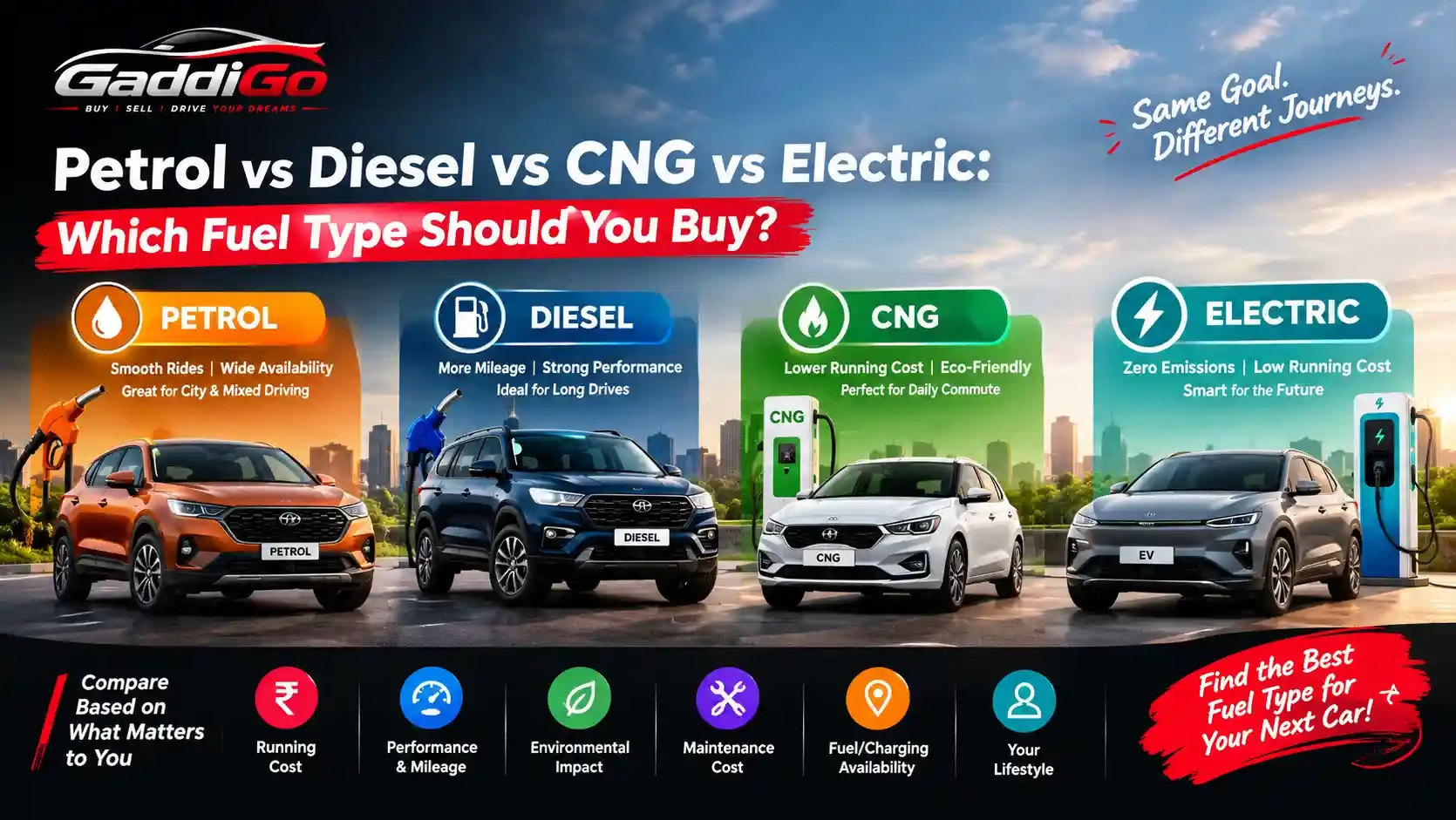
If you drive regularly and want to reduce your fuel expenses, a CNG car can be a practical choice. Compressed Natural Gas (CNG) vehicles are popular in India because they can offer lower fuel costs than petrol cars, making them suitable for daily office commutes, family trips, and frequent city driving.
In 2026, buyers can choose from several factory-fitted CNG cars, including budget hatchbacks, premium hatchbacks, compact SUVs, sedans, and family MPVs. Models such as the Maruti Suzuki Swift, Dzire, Wagon R, Baleno, Tata Tiago, Tata Punch, and Maruti Suzuki Ertiga offer different combinations of mileage, comfort, space, and affordability.
But which model is right for you? The answer depends on your budget, daily driving distance, family size, local CNG availability, and the features you need.
In this guide, we compare some of the best CNG cars in India in 2026, explain their mileage and running costs, and share useful tips to help you choose the right vehicle.
1. Why Should You Consider a CNG Car in 2026?
CNG cars can help reduce everyday fuel expenses, especially if you travel long distances regularly.
Here are some advantages of choosing a CNG vehicle:
-
Lower fuel expenses: CNG can cost less per kilometre than petrol in many cities.
-
Suitable for daily commuting: A practical option for office travel, school runs, and regular city journeys.
-
Factory-fitted technology: Manufacturer-installed CNG systems are designed and tested for the specific vehicle.
-
Multiple vehicle choices: Buyers can choose from hatchbacks, sedans, compact SUVs, and MPVs.
-
Petrol backup in many models: Bi-fuel cars can switch to petrol when CNG is unavailable, depending on the model.
However, CNG cars also have limitations. Performance can feel different when running on CNG, refuelling stations may not be equally accessible everywhere, and the cylinder can reduce conventional boot space in some vehicles.
Before buying, consider your daily travel needs rather than choosing a car based on mileage alone.
2. Best CNG Cars in India 2026
Here are some popular factory-fitted CNG cars worth considering. The mileage figures below are indicative claimed figures for relevant variants; check the manufacturer's current specifications before purchasing.
| Car model | Best suited for | Indicative claimed mileage |
|---|---|---|
| Maruti Suzuki Alto K10 CNG | Budget-conscious city driving | Up to 33.9 km/kg |
| Maruti Suzuki Wagon R CNG | Everyday family use | Up to 34 km/kg, variant-dependent |
| Maruti Suzuki Swift CNG | City and highway commuting | Up to 32.85 km/kg |
| Maruti Suzuki Dzire CNG | Families wanting a sedan | Up to 34–36 km/kg, variant-dependent |
| Maruti Suzuki Baleno CNG | Premium hatchback buyers | Up to 33.61 km/kg |
| Tata Tiago CNG | Affordable hatchback buyers | Check current variant specifications |
| Tata Punch CNG | Buyers wanting SUV styling | Around 26.99 km/kg |
| Maruti Suzuki Ertiga CNG | Larger families | Around 26 km/kg |
Figures are indicative, not guaranteed real-world results. Mileage depends on the exact model year and variant. Manufacturer-claimed figures and independent road-test results can differ.
3. Maruti Suzuki Alto K10 CNG: A Budget-Friendly Choice
The Maruti Suzuki Alto K10 CNG is worth considering if you want a compact car for everyday city driving without spending too much on the purchase.
Its small dimensions can make parking and navigating crowded roads easier. It may suit first-time car buyers, small families, and people who primarily travel short distances in urban areas.
Why consider it?
-
Compact size for city use
-
Budget-oriented ownership
-
Suitable for regular commuting
-
Claimed mileage of up to approximately 33.9 km/kg, depending on the variant
Things to consider: The cabin and luggage space are more limited than in larger hatchbacks or SUVs. If you regularly travel with several passengers and luggage, compare it with other models before deciding.
4. Maruti Suzuki Wagon R CNG: Practical for Daily Use
The Wagon R is a popular choice among buyers who want an upright seating position, practical cabin space, and easy everyday usability.
Its tall-boy design can make getting in and out more convenient for many passengers. It can be suitable for small families, city commuters, and drivers who frequently travel through congested urban areas.
Key benefits:
-
Practical cabin layout
-
Easy-to-drive dimensions
-
Suitable for daily family use
-
CNG option designed to reduce fuel expenses
Things to consider: Check the available luggage space with the CNG cylinder installed and confirm the exact mileage and features of your preferred variant.
5. Maruti Suzuki Swift CNG: A Good All-Rounder
The Swift CNG is worth considering if you want a hatchback that balances everyday practicality with a more youthful design.
It can suit office commuters, small families, and drivers who need a car for both city traffic and occasional longer journeys.
The manufacturer-claimed fuel efficiency for the Swift CNG has been reported at up to 32.85 km/kg for certain versions. Actual mileage can be lower depending on traffic, air-conditioning use, driving style, and road conditions.
Why consider the Swift CNG?
-
Compact hatchback design
-
Suitable for everyday commuting
-
Familiar model with a broad service network
-
A balance of practicality and driving convenience
Things to consider: Compare the CNG and petrol variants' prices, features, and transmission options. A higher initial purchase price may take time to recover through fuel savings.
6. Maruti Suzuki Dzire CNG: A Practical Sedan
The Dzire CNG can be a good option for buyers who prefer a sedan body style and want to manage regular fuel expenses.
It may suit families, professionals, and people who need a comfortable vehicle for everyday commuting.
Maruti Suzuki introduced automatic S-CNG versions of the Swift, Dzire, and Baleno in 2026. The company reported a certified fuel-efficiency figure of 36.47 km/kg for the Dzire automatic S-CNG. Check the latest variant specifications and availability before making a purchase.
Key benefits:
-
Sedan-style design
-
Useful for family and office travel
-
Potentially low fuel cost per kilometre
-
Automatic option available in the announced S-CNG range
Things to consider: Compare boot capacity, rear-seat comfort, equipment, and the price difference between manual and automatic versions.
7. Maruti Suzuki Baleno CNG: A Premium Hatchback Option
The Baleno CNG is worth exploring if you want a hatchback with a more premium feel and practical cabin space.
It can suit families and commuters who want a combination of everyday comfort, useful features, and fuel efficiency.
Maruti Suzuki lists a claimed mileage of up to 33.61 km/kg for the Baleno CNG range. The company also introduced an automatic S-CNG version in 2026, so buyers should check the latest variant lineup.
Why consider it?
-
Premium hatchback positioning
-
Practical for everyday family use
-
Competitive claimed fuel efficiency
-
Manual and newer automatic options, depending on availability
Things to consider: Compare the Baleno with the Swift and other hatchbacks to see whether the additional purchase price is justified by the cabin, features, and comfort you receive.
8. Tata Tiago CNG: An Affordable Alternative
The Tata Tiago CNG is an option for buyers who want a compact hatchback with a factory-fitted CNG system.
Its size makes it suitable for city driving, while the hatchback body style can work for small families and everyday errands.
Potential advantages:
-
Compact dimensions
-
Practical for regular city travel
-
Factory-fitted CNG option
-
A useful alternative to other budget hatchbacks
Things to consider: Confirm the exact variant's claimed mileage, safety equipment, warranty terms, and boot space. Compare the on-road price with similar models before making a decision.
9. Tata Punch CNG: For Buyers Who Prefer SUV Styling
The Tata Punch CNG is worth considering if you want a higher-riding compact vehicle rather than a conventional hatchback.
It may suit urban families who prefer SUV-inspired styling and want a practical vehicle for everyday use.
The Punch CNG has a claimed fuel-efficiency figure of approximately 26.99 km/kg for relevant variants.
Why consider it?
-
Compact SUV-inspired design
-
Higher seating position than many hatchbacks
-
Suitable for city commuting and family use
-
Factory-fitted CNG option
Things to consider: Mileage may be lower than that of some smaller hatchbacks. Test the car on your usual routes and check how the CNG storage arrangement affects luggage space.
10. Maruti Suzuki Ertiga CNG: For Larger Families
If you need more passenger capacity, the Ertiga CNG is worth considering. It is a family-oriented MPV that can accommodate up to seven occupants in relevant configurations.
It may suit larger families, shared travel, and people who frequently need additional seating.
Key benefits:
-
Multi-row seating
-
Practical family-oriented design
-
Suitable for frequent passenger travel
-
CNG option for potentially lower fuel expenses
Things to consider: The purchase price is higher than that of small hatchbacks. Passenger load, luggage requirements, and available boot space should be checked carefully before buying.
11. How Much Does It Cost to Run a CNG Car?
The main reason many buyers consider CNG is its potential to reduce running costs.
Your fuel expense depends on the local CNG price and the mileage you actually achieve. To estimate the cost, divide the price of one kilogram of CNG by the mileage in kilometres per kilogram.
Formula:
Cost per kilometre = CNG price per kg ÷ actual mileage in km/kg
For example, suppose CNG costs ₹90 per kg and your car delivers 25 km/kg in everyday driving.
-
CNG price: ₹90 per kg
-
Actual mileage: 25 km/kg
-
Approximate fuel cost: ₹3.60 per kilometre
If you drive 1,500 km per month, your estimated monthly CNG expense would be ₹5,400.
These figures are illustrative only. Use the current CNG price in your city and your own vehicle's actual mileage for a more accurate estimate.
Example: Estimated monthly fuel expense
Assuming a CNG price of ₹90/kg and driving 1,500 km per month:
| Actual mileage | Approx. cost per km | Monthly fuel cost |
|---|---|---|
| 20 km/kg | ₹4.50 | ₹6,750 |
| 25 km/kg | ₹3.60 | ₹5,400 |
| 30 km/kg | ₹3.00 | ₹4,500 |
| 33 km/kg | ₹2.73 | ₹4,091 |
The table excludes maintenance, insurance, loan interest, depreciation, and the additional purchase cost of the CNG variant.
12. CNG vs Petrol: Which Is More Economical?
A CNG car may cost less to fuel, but you should compare the overall ownership cost before buying.
Consider an example:
-
Petrol price: ₹105 per litre
-
Petrol mileage: 15 km/litre
-
CNG price: ₹90 per kg
-
CNG mileage: 25 km/kg
In this example, petrol costs approximately ₹7 per kilometre, while CNG costs ₹3.60 per kilometre.
That is a potential fuel saving of ₹3.40 per kilometre.
At 1,500 km per month, the difference would be approximately ₹5,100 per month, or ₹61,200 over 12 months, assuming those prices and mileage figures remain constant.
These are hypothetical calculations, not a guarantee of savings. Your result may be different because petrol and CNG prices, actual mileage, and driving conditions vary.
Also compare the extra purchase price of the CNG variant. The more you drive, the easier it may be to recover that additional cost through fuel savings.
13. Important Things to Check Before Buying a CNG Car
Before choosing a CNG car, look beyond its advertised mileage.
Check CNG availability in your area
Look for reliable CNG stations near your home, workplace, and regular travel routes. Limited availability can make daily refuelling inconvenient.
Compare the initial purchase price
Calculate the price difference between the petrol and CNG versions. Estimate how many months or years of fuel savings you might need to recover that difference.
Check boot space
Many CNG cars store the cylinder in the boot. Inspect the actual luggage area and see whether it meets your family's needs. Some models use alternative cylinder arrangements to preserve more storage space.
Consider performance
A CNG engine may deliver different performance compared with petrol operation. Test-drive the car on city roads and, if relevant, inclines or highways.
Review safety and warranty details
Prefer a factory-fitted CNG vehicle from the manufacturer. Check the warranty, scheduled servicing requirements, and the recommended inspection intervals for the CNG system.
Calculate total ownership cost
Include insurance, maintenance, tyres, loan costs, depreciation, and the fuel savings you expect to achieve.
14. Should You Buy a New or Used CNG Car?
A new CNG car gives you access to the latest available features and a manufacturer warranty, subject to its terms. A used CNG car may have a lower purchase price, but it requires careful inspection.
When considering a used CNG vehicle, check:
-
Vehicle service and maintenance history
-
CNG system inspection records
-
Cylinder testing and certification records, as applicable
-
Registration Certificate (RC) details
-
Insurance validity
-
Accident and repair history
-
Engine performance in both available fuel modes
-
Outstanding loans or ownership-transfer issues
Have the vehicle inspected by a qualified mechanic familiar with CNG systems. Verify that the installation is approved and properly documented.
If you are comparing pre-owned cars, you can explore GaddiGo for car-related information and options to support your buying or selling research.
Final Thoughts
The best CNG car in India in 2026 depends on your budget, driving habits, family requirements, and local fuel availability.
The Alto K10 and Wagon R are worth considering for everyday city use. The Swift and Baleno can suit hatchback buyers, while the Dzire is an option for those who prefer a sedan. The Tata Punch offers SUV-inspired styling, and the Ertiga is worth exploring if you need additional passenger capacity.
Do not choose a car based only on its claimed mileage. Compare the on-road price, real-world fuel expenses, boot space, service support, and expected annual driving distance.
If you are exploring car options, visit GaddiGo.com to continue your car research and make a more informed decision.
Frequently Asked Questions
1. Which is the best CNG car in India in 2026?
There is no single best option for every buyer. The Alto K10 and Wagon R may suit budget-conscious city users, the Swift and Baleno may suit hatchback buyers, the Dzire may appeal to sedan buyers, and the Ertiga may suit larger families.
2. Which CNG car gives the highest mileage?
Some Maruti Suzuki CNG models offer claimed mileage figures above 33 km/kg. The exact figure depends on the model, variant, and transmission. Always check current manufacturer specifications and remember that real-world mileage can be lower.
3. Are CNG cars cheaper to run than petrol cars?
They can be, particularly when CNG is significantly cheaper than petrol per kilometre. Calculate the cost using current local fuel prices and actual mileage before deciding.
4. Is a CNG car suitable for long-distance travel?
Yes, it can be suitable if CNG stations are available along your route. Plan refuelling stops before travelling through areas with limited CNG infrastructure.
5. Does a CNG cylinder reduce boot space?
In many models, the cylinder occupies part of the boot. Some vehicles use alternative cylinder layouts to preserve luggage space. Inspect the exact car before buying.
6. Is it better to buy a factory-fitted CNG car?
A factory-fitted CNG model is generally preferable because the manufacturer designs and tests the system for that vehicle. If considering a retrofit, verify its legality, approval, installation quality, documentation, and warranty implications.
7. How can I calculate the running cost of a CNG car?
Divide the local CNG price per kilogram by the actual mileage in kilometres per kilogram. Multiply the result by your monthly driving distance to estimate your monthly fuel expense.
8. Is a used CNG car worth buying?
It can be a good option if the vehicle is well maintained, appropriately documented, and priced fairly. Check the service history, CNG system records, insurance, RC, and overall mechanical condition before buying.