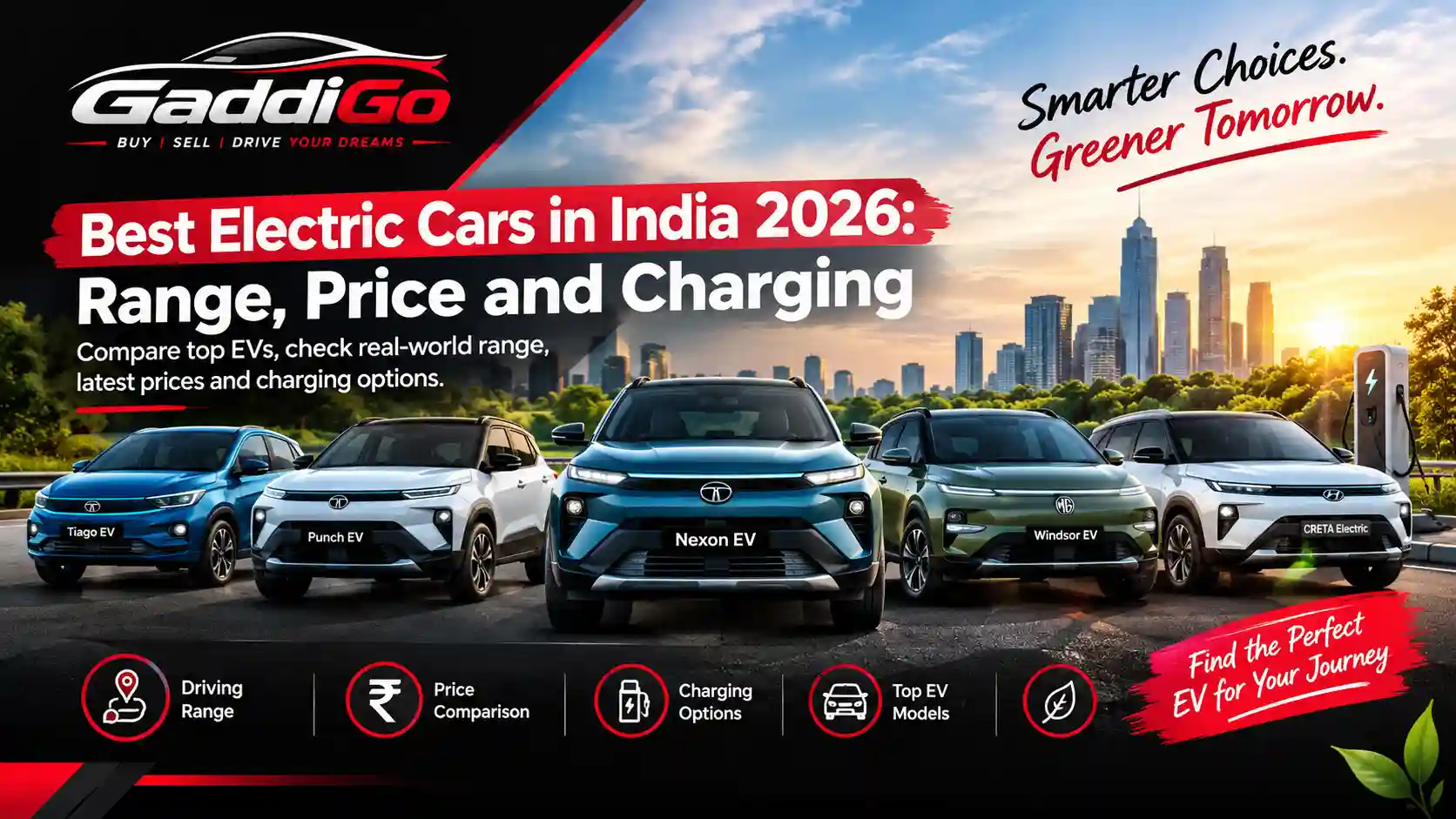
Electric cars are becoming an increasingly attractive option for Indian buyers who want lower running costs, a quieter driving experience, and modern technology. With options ranging from compact city cars to premium electric SUVs, there is now an EV for different budgets and driving requirements.
However, choosing the right electric car involves more than comparing the advertised range. Buyers should also consider the purchase price, charging time, battery warranty, service availability, boot space, and access to home or public charging.
In this guide, we explore some of the best electric cars in India in 2026, compare their claimed driving ranges and indicative prices, and explain how to choose an EV that suits your needs.
Best Electric Cars in India 2026: Quick Comparison
The following table provides a starting point for comparing popular electric cars. Prices and ranges are indicative and can vary by variant, location, battery configuration, and current manufacturer offers.
| Electric car | Approximate ex-showroom price | Claimed range (approx.) | Best suited for |
|---|---|---|---|
| Tata Tiago EV | From ₹7 lakh* | Up to 315 km, depending on version | Budget-conscious city drivers |
| Tata Punch EV | Varies by variant | Up to around 355 km, depending on version | Compact SUV buyers |
| Tata Nexon EV | From around ₹12.5 lakh* | Up to around 489 km, depending on version | Families and everyday use |
| MG Windsor EV | From around ₹14.85 lakh* | Up to 449 km for Pro versions | Comfort and cabin space |
| Hyundai CRETA Electric | From around ₹18 lakh* | Up to 510 km | Family SUV buyers |
| Maruti Suzuki e VITARA | Pricing depends on ownership plan and variant | Up to 543 km | Buyers seeking an electric SUV and broad service support |
| Mahindra BE 6 | Varies by battery and variant | Up to around 682 km for selected versions | Performance and technology enthusiasts |
| Tata Harrier EV | Varies by battery and variant | Up to around 627 km for selected versions | Buyers seeking a larger electric SUV |
| Hyundai IONIQ 5 | Around ₹55 lakh and above | Up to around 631 km, depending on specification | Premium EV buyers |
*Prices are indicative, not guaranteed current offers. Some models have Battery-as-a-Service (BaaS) plans that reduce the upfront vehicle price but charge separately for battery usage. Compare the complete ownership cost before deciding.
Driving-range figures are manufacturer-claimed or certified figures for particular variants. Real-world range may be lower depending on speed, traffic, weather, air-conditioning use, road conditions, load, and driving style.
1. Tata Tiago EV: A Practical Choice for City Driving
The Tata Tiago EV is worth considering if you want a relatively affordable electric car for daily commuting. Its compact dimensions make it convenient for city traffic, parking, and short trips.
Why consider the Tata Tiago EV?
-
Compact size for crowded urban roads.
-
Lower energy costs than a comparable petrol car in many home-charging situations.
-
Suitable for regular commuting and local errands.
-
Multiple battery and feature configurations, depending on the model year.
What should you consider?
The Tiago EV is primarily a city-focused option. If you frequently travel long distances between cities, check the range of the exact variant and the charging facilities along your regular route.
Best for: First-time EV buyers, daily office commutes, and households looking for a smaller electric car.
2. Tata Punch EV: An Electric Car with SUV Styling
The Tata Punch EV combines a compact footprint with SUV-inspired styling and a relatively high seating position. It may suit buyers who want something more versatile than a small hatchback without moving to a much larger vehicle.
Key advantages
-
Compact dimensions for urban driving.
-
SUV-inspired design and seating position.
-
Battery options that offer different balances of price and range.
-
Practical everyday usability for individuals and small families.
Charging and range
The claimed range varies by battery pack and variant. Before buying, check the latest specification sheet and compare the range of the exact version you can afford.
If your daily commute is predictable and you can charge at home, the Punch EV may be a convenient option. For frequent highway journeys, check fast-charger availability and plan your stops in advance.
Best for: City commuters who prefer compact SUV styling and everyday practicality.
3. Tata Nexon EV: A Well-Rounded Family Option
The Tata Nexon EV is a popular model to consider if you want an electric SUV for everyday family use. It offers a combination of SUV proportions, useful cabin space, and battery options intended for different driving needs.
Why consider the Nexon EV?
-
Practical size for daily use and family travel.
-
Multiple variants with different equipment and battery configurations.
-
A claimed range that can be suitable for regular commuting and selected longer journeys.
-
SUV styling and a more substantial road presence than smaller EVs.
Is it suitable for long trips?
That depends on the variant, your route, and charging availability. Check the exact certified range, then plan with a buffer rather than assuming you will achieve the full advertised distance in everyday conditions.
Also compare the cost of home charging, public fast charging, insurance, servicing, and battery warranty.
Best for: Families looking for a versatile electric SUV for commuting and occasional trips.
4. MG Windsor EV: Comfort and Cabin Space
The MG Windsor EV is an electric crossover-style vehicle that places particular emphasis on passenger comfort and interior space. It is worth considering if you want a spacious cabin for everyday family use.
Key highlights
-
Comfortable seating and a spacious-feeling interior.
-
Large infotainment display and connected features, depending on variant.
-
Battery options offering different claimed ranges.
-
Available Battery-as-a-Service ownership plans on eligible versions.
The Windsor EV's Pro versions are listed with a claimed range of up to 449 km, depending on the variant. The official MG Windsor EV page provides current variant information and pricing.
Understand the BaaS pricing
Under a Battery-as-a-Service plan, the upfront vehicle price may be lower because battery usage is billed separately. Do not compare this starting price directly with the full purchase price of another EV.
Calculate the total cost using your expected kilometres, battery usage charges, financing, and ownership period.
Best for: Buyers who prioritise cabin comfort, passenger space, and a relaxed driving experience.
5. Hyundai CRETA Electric: A Family SUV with Long-Range Options
The Hyundai CRETA Electric brings the familiar SUV format to an electric powertrain. It may suit buyers who want a family-friendly vehicle with modern technology, a choice of battery packs, and charging flexibility.
Key highlights
-
42 kWh and 51.4 kWh battery options.
-
Manufacturer-claimed range of up to 510 km for the long-range version.
-
DC fast-charging support.
-
Features such as connected technology and advanced driver-assistance features on selected variants.
Hyundai lists the CRETA Electric's certified range at up to 420 km for the 42 kWh version and up to 510 km for the 51.4 kWh version.
What about the price?
Hyundai has also introduced a Battery-as-a-Service option with a lower upfront price and a separate per-kilometre battery charge. Check the official CRETA Electric page for the applicable variant and ownership terms.
Best for: Families who want an electric SUV for daily use, longer commutes, and occasional highway travel.
6. Maruti Suzuki e VITARA: An Electric SUV to Consider
The Maruti Suzuki e VITARA adds another option for buyers who want an electric SUV from a manufacturer with a broad presence in India.
Key highlights
-
Two battery options: 49 kWh and 61 kWh.
-
Claimed range of up to 543 km for selected versions.
-
Home-charging support and access to the manufacturer's EV charging ecosystem.
-
A battery warranty and ownership plans subject to the applicable terms.
Maruti Suzuki has announced a Battery-as-a-Service plan that separates the upfront vehicle cost from battery usage charges. The company also lists home-charging support and a charging network through its EV services.
Before choosing a BaaS plan, compare its per-kilometre charge with the cost of buying the vehicle and battery outright. The cheaper entry price may not be the cheapest option over your full ownership period.
Best for: Buyers looking for an electric SUV with a choice of battery packs and a manufacturer-backed service ecosystem.
7. Mahindra BE 6: For Performance and Technology
The Mahindra BE 6 is worth exploring if you prefer a distinctive electric SUV design, strong performance, and a technology-focused cabin.
Why consider the BE 6?
-
Bold, sporty exterior styling.
-
Multiple battery and equipment configurations.
-
Long claimed range on selected versions.
-
Modern infotainment and connected features.
Mahindra's newer BE 6 SPORTEQ range includes different battery and variant options, with BaaS pricing available on selected versions. The manufacturer's published information lists a range of prices depending on the battery and configuration.
Who should choose it?
The BE 6 may appeal to drivers who want more than basic city transport. However, compare its dimensions, visibility, ride comfort, insurance, tyres, charging needs, and total ownership cost with more practical family-focused alternatives.
Best for: Buyers who prioritise performance, distinctive styling, and technology.
8. Tata Harrier EV: A Larger Electric SUV
The Tata Harrier EV is worth considering if you want a larger electric SUV with a more substantial road presence and a focus on longer-distance capability.
Key points to evaluate
-
Battery and drivetrain configuration.
-
Claimed range of the exact variant.
-
Cabin and luggage space for your family.
-
Home-charging installation requirements.
-
Availability of suitable public fast chargers on your regular routes.
-
Purchase price, insurance, and replacement-tyre costs.
Selected versions have been advertised with a claimed range of up to around 627 km. Confirm the current specification and price for the exact variant before relying on that figure.
A larger battery can provide more range, but it can also raise the purchase price. Choose based on your actual driving requirements rather than range alone.
Best for: Buyers who want a larger electric SUV and can accommodate its purchase and running costs.
9. Hyundai IONIQ 5: A Premium Electric Car
The Hyundai IONIQ 5 is a premium electric vehicle aimed at buyers who want a modern design, a spacious interior, and advanced charging technology.
Key advantages
-
Distinctive exterior and interior design.
-
Dedicated electric-vehicle platform.
-
Premium cabin and technology features.
-
Fast-charging capability with compatible high-power equipment.
Its price is significantly higher than that of smaller mass-market EVs, so buyers should evaluate whether the premium features and driving experience justify the additional expense.
Charging speed also depends on the charger, battery temperature, state of charge, and other conditions. A compatible ultra-fast charger can reduce waiting time, but such infrastructure is not available everywhere.
Best for: Premium EV buyers who value design, comfort, technology, and rapid charging.
How to Choose the Best Electric Car for Your Budget
There is no single best EV for every buyer. Use your daily driving needs and total budget to narrow the options.
If your budget is limited
Start by comparing compact models such as the Tata Tiago EV and Tata Punch EV. Look at the entry variant's features, battery size, warranty, and actual on-road price rather than just the advertised starting price.
If you need a family car
Compare the Tata Nexon EV, MG Windsor EV, and Hyundai CRETA Electric. Evaluate rear-seat comfort, boot space, safety equipment, range, and service access in your city.
If you travel long distances
Consider variants with a longer certified range, but also map the public fast chargers along your regular routes. A long-range EV is less convenient for highway travel if suitable chargers are far apart or frequently unavailable.
If you want a premium electric SUV
Explore the Mahindra BE 6, Tata Harrier EV, and other premium options based on their current variants, price, performance, and charging requirements.
Electric Car Charging in India: What You Need to Know
Charging convenience is one of the most important factors when choosing an electric car.
1. Home charging
For many owners, home charging is the most convenient option. A compatible AC wall-box charger can recharge the car while it is parked overnight.
Before installation, check:
-
Whether your parking space has suitable electrical access.
-
Whether your building or housing society permits charger installation.
-
The electrical connection and load requirements.
-
The cost of installation and any necessary upgrades.
-
Whether the charger is compatible with your car.
Charging time depends on battery capacity, charger power, the car's onboard charger, and the battery's current charge level.
2. Public AC charging
Public AC chargers may be useful when your vehicle remains parked for several hours at a workplace, shopping centre, hotel, or other destination.
Check the charger type and connector compatibility before relying on a particular station.
3. DC fast charging
DC fast chargers can be useful for highway stops and situations where you need to add range more quickly. Charging from 10% to 80% may take around 30–60 minutes on some models, but the actual time varies considerably.
Charging usually slows as the battery approaches a high state of charge. Charger power, battery temperature, and the vehicle's charging curve also influence the time required.
Use the car manufacturer's recommended charging practices and check current charger availability before starting a long trip.
How Much Does It Cost to Charge an Electric Car?
The cost depends on your car's energy consumption, the amount of energy added, and the tariff charged by your electricity provider or public charging operator.
A simple estimate is:
Charging cost = Electricity consumed (kWh) × Electricity rate per kWh
For example, if your car uses 15 kWh of electricity for a 100 km journey and your effective electricity rate is ₹8 per kWh:
-
Energy used: 15 kWh
-
Electricity rate: ₹8 per kWh
-
Estimated electricity cost: ₹120 per 100 km
This is an illustration, not a universal running-cost figure. Actual consumption varies by car and driving conditions, while charging losses can increase the amount of electricity drawn from the grid. Public charging may cost more than home charging.
Compare this with the fuel cost of a petrol or diesel vehicle that covers the same distance. Include servicing, insurance, tyres, financing, and depreciation when estimating overall savings.
Important Things to Check Before Buying an Electric Car
Before booking an EV, review the following checklist:
-
Real-world range: Choose a model with enough range for your daily travel, plus a reasonable buffer.
-
Battery warranty: Read the duration, kilometre limits, and exclusions.
-
Charging access: Confirm home installation options and public-charger availability.
-
On-road price: Include insurance, registration, charger installation, and applicable fees.
-
BaaS terms: If offered, calculate battery charges over your expected ownership period.
-
Service network: Check the availability of authorised service centres near you.
-
Battery and vehicle warranty: Understand the conditions for coverage and repairs.
-
Resale value: EV resale prices can vary with battery condition, new-model pricing, and market demand.
-
Test drive: Check ride comfort, visibility, braking, cabin space, and driving feel.
-
Total ownership cost: Compare the full cost over the number of years you plan to keep the car.
Are Electric Cars Worth Buying in India in 2026?
An electric car can be a practical choice if you drive regularly, can charge conveniently, and select a model that fits your travel requirements.
Potential benefits include lower energy costs in many home-charging situations, quiet operation, and fewer routine powertrain service items than a conventional petrol or diesel car. However, the initial purchase price, charging access, insurance, depreciation, and battery-related terms all matter.
EV ownership may be especially convenient for people with a predictable daily commute and dedicated parking. If you regularly drive long distances through areas with limited charging infrastructure, a petrol, diesel, hybrid, or other option may be worth comparing.
The best decision comes from looking at your actual driving pattern rather than choosing an electric car based on its advertised range alone.
Frequently Asked Questions
1. Which is the best electric car in India in 2026?
The best choice depends on your budget and requirements. The Tata Tiago EV may suit city driving, the Tata Nexon EV and Hyundai CRETA Electric are options for family use, while the Mahindra BE 6 and Tata Harrier EV target buyers looking for larger or more performance-focused electric SUVs.
2. Which electric car offers the longest range?
Range depends on the exact model year, variant, and test cycle. Some versions of the Mahindra BE 6, Maruti Suzuki e VITARA, Hyundai IONIQ 5, and Tata Harrier EV advertise long certified ranges. Compare official figures for the exact variants and remember that real-world range is often lower.
3. How long does it take to charge an electric car?
Home AC charging may take several hours, often overnight. DC fast charging can be considerably quicker, with some vehicles taking roughly 30–60 minutes to charge from 10% to 80% under suitable conditions. Actual time varies by model, charger, temperature, and battery level.
4. Are electric cars cheaper to run than petrol cars?
They can be cheaper to run, particularly when charged at home and driven regularly. However, savings depend on electricity tariffs, public charging costs, energy consumption, fuel prices, insurance, maintenance, and depreciation.
5. Can I charge an electric car at home?
Yes, many electric cars support home AC charging with compatible equipment. You should confirm the electrical requirements, parking arrangements, and installation permissions before purchasing the vehicle.
6. What is Battery-as-a-Service (BaaS)?
BaaS is an ownership model in which the battery cost is separated from the initial vehicle price, with battery usage charged separately under the plan's terms. It can reduce the upfront cost, but buyers should calculate the total cost based on their expected mileage and ownership period.
Final Thoughts
The best electric cars in India in 2026 offer a wide range of choices, from compact city vehicles to premium electric SUVs. The right option depends on your budget, daily distance, charging access, family needs, and preferred driving experience.
Compare claimed range, charging capability, warranty, and total ownership cost before making a decision. Take a test drive and verify the latest variant pricing with the manufacturer or authorised dealer.
If you are comparing vehicles before your next purchase, visit GaddiGo to explore car-related information and make a more informed buying decision.