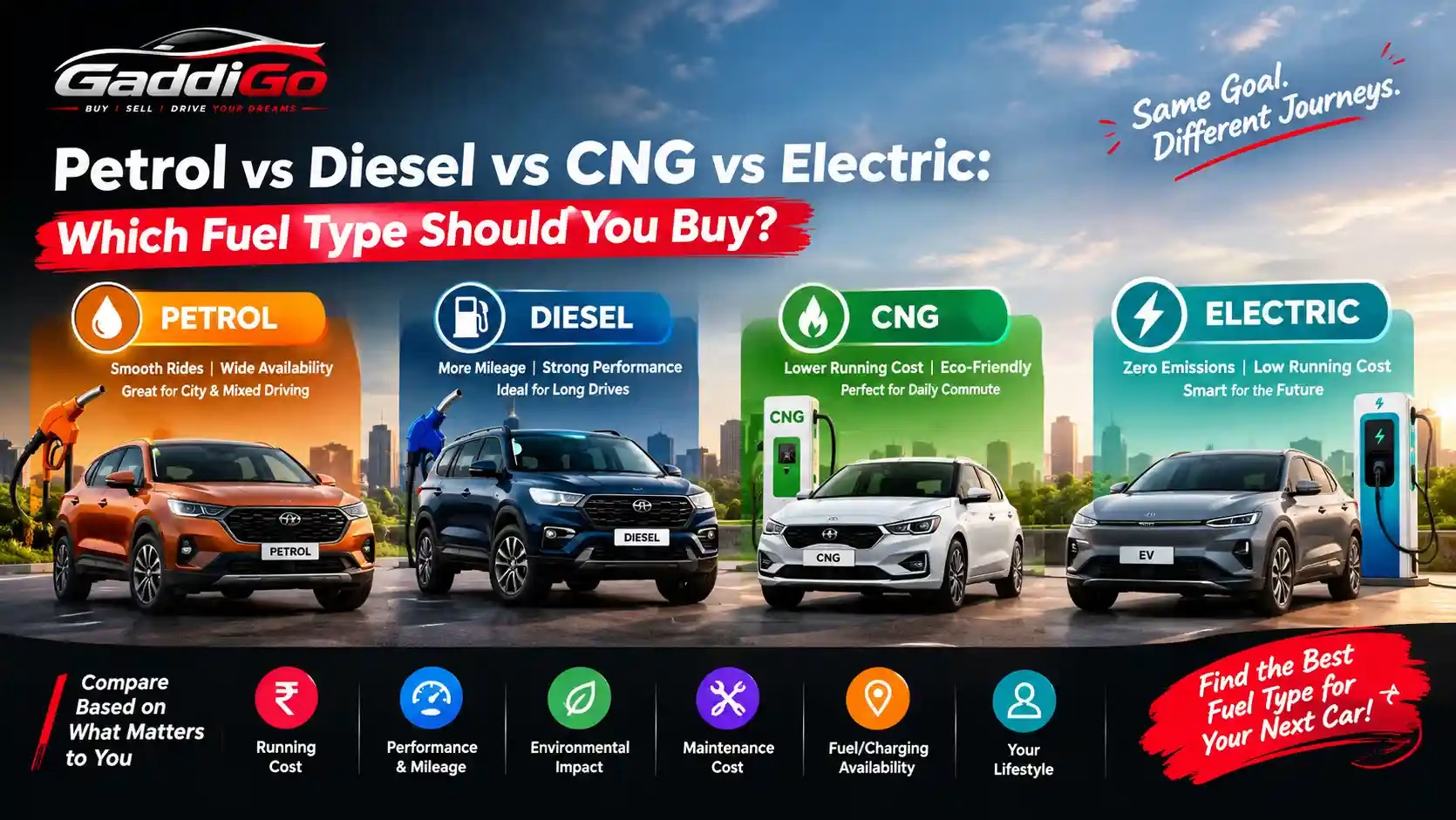
Buying a car in India involves more than choosing a brand, model, or budget. One important decision is selecting the right fuel type. With petrol, diesel, CNG, and electric cars available, buyers often wonder which option offers the best balance of running costs, performance, convenience, and long-term savings.
The right choice depends on how much you drive, your daily commute, your budget, the availability of fuel or charging facilities, and how long you plan to keep the car.
In this guide, we compare petrol vs diesel vs CNG vs electric cars to help you choose the best fuel type for your needs.
Petrol vs Diesel vs CNG vs Electric: Quick Comparison
| Factor | Petrol | Diesel | CNG | Electric |
|---|---|---|---|---|
| Purchase cost | Often lower | Often higher than petrol equivalents | Varies by model | Often higher upfront |
| Running cost | Moderate to high | Often efficient on long trips | Generally low where CNG is affordable | Often low when charging at home |
| Best suited for | City and mixed driving | High-mileage and highway use | Frequent city commuters | Daily commuting with charging access |
| Driving experience | Smooth and responsive | Strong low-speed pulling power | Practical for economical driving | Quiet, smooth, instant acceleration |
| Refuelling or charging | Usually convenient | Usually convenient | Depends on CNG station availability | Requires charging access and planning |
| Maintenance | Conventional engine servicing | Engine and emissions-system maintenance | Petrol engine plus CNG-system checks | Fewer moving powertrain parts |
| Long-distance travel | Generally convenient | Generally convenient | Requires route planning | Depends on range and charging network |
| Environmental impact | Tailpipe emissions | Tailpipe emissions, including particulates and nitrogen oxides | Fossil-fuel emissions remain | No tailpipe emissions; electricity generation and battery production also matter |
Costs and performance vary by model, local fuel prices, electricity tariffs, driving conditions, and vehicle technology.
1. Petrol Cars: Best for Everyday Flexibility
Petrol cars remain a popular option for Indian buyers because they are widely available across different price ranges and are generally easy to refuel.
Advantages of petrol cars
-
Often have a lower purchase price than comparable diesel models.
-
Offer smooth and responsive driving for everyday use.
-
Petrol stations are widely available.
-
Suit city driving, occasional highway trips, and mixed usage.
-
Can be a practical option for people who drive relatively few kilometres annually.
Disadvantages of petrol cars
-
Fuel expenses can add up if you drive long distances regularly.
-
Heavy traffic and short trips can reduce real-world fuel efficiency.
-
Running costs may be higher than CNG or home-charged electric driving, depending on local prices.
Who should buy a petrol car?
Choose petrol if you want a straightforward all-rounder, drive mostly in the city, take occasional road trips, and do not want to depend on charging infrastructure or find a CNG station.
2. Diesel Cars: Better for High-Mileage Drivers
Diesel engines are often considered by buyers who cover long distances regularly. They can offer strong torque and good highway fuel efficiency, making them suitable for certain driving patterns.
Advantages of diesel cars
-
Often deliver strong pulling power, especially useful on highways and with heavier loads.
-
Can offer good fuel efficiency on long journeys.
-
May make financial sense for drivers with consistently high annual mileage, depending on the purchase-price difference and fuel prices.
Disadvantages of diesel cars
-
Comparable diesel variants often cost more upfront.
-
Some models may have higher maintenance or emissions-system repair costs.
-
Modern diesel vehicles may need suitable driving conditions for emissions-control systems to function properly.
-
Local vehicle-age rules, registration conditions, and restrictions may affect ownership in some areas.
Who should buy a diesel car?
A diesel car may suit people who regularly drive long highway distances or cover substantial annual kilometres. Compare the price premium and expected ownership costs before choosing diesel over petrol.
Do not assume diesel always saves money. Your annual mileage and the actual price difference between variants matter.
3. CNG Cars: A Practical Option for Budget-Conscious Commuters
Compressed Natural Gas (CNG) cars are popular among buyers looking to reduce daily fuel expenses. Many factory-fitted CNG vehicles are based on petrol models and can switch between the two fuels.
Advantages of CNG cars
-
CNG can offer a lower cost per kilometre than petrol in many locations.
-
Factory-fitted options are available across several vehicle categories.
-
Petrol operation can provide additional flexibility in compatible bi-fuel vehicles.
-
CNG may be attractive for frequent city commuters and high-usage drivers.
Disadvantages of CNG cars
-
CNG stations are not equally accessible in every city or neighbourhood.
-
The CNG cylinder takes up space that may otherwise be used for luggage.
-
Some CNG variants have lower power output than their petrol equivalents.
-
The purchase price may be higher than that of a comparable petrol variant.
-
Refuelling queues and station availability can affect convenience.
Who should buy a CNG car?
Consider CNG if you drive frequently, have reliable CNG stations near your home or workplace, and want to reduce running expenses. Before buying, check the boot space and compare the factory-fitted CNG variant with the petrol version.
For safety and reliability, prefer manufacturer-approved CNG systems and follow the required inspection and maintenance schedule.
4. Electric Cars: Best for Drivers With Convenient Charging
Electric vehicles (EVs) use a battery-powered motor instead of a conventional petrol or diesel engine. They can be especially attractive for daily commuting when charging is available at home or work.
Advantages of electric cars
-
Home charging can provide a low cost per kilometre, depending on electricity tariffs.
-
Electric motors deliver immediate torque and smooth acceleration.
-
EVs have no tailpipe emissions.
-
They have fewer conventional powertrain components that require servicing.
-
Regenerative braking can help recover energy during deceleration.
Disadvantages of electric cars
-
Purchase prices can be higher than comparable petrol models.
-
Public charging availability varies by location and route.
-
Highway trips require planning around range, charging speed, and charger availability.
-
Charging may be inconvenient if you live in a building without a suitable charging facility.
-
Battery condition, warranty coverage, replacement costs, and resale value deserve attention, particularly when buying a used EV.
Who should buy an electric car?
An electric car may be a strong choice if you have dependable home or workplace charging, mostly drive predictable daily routes, and want to reduce routine running costs. If you regularly travel long distances, check the vehicle's real-world range and charging options along your usual routes.
Petrol vs Diesel vs CNG vs Electric: Which Is Cheaper to Run?
The best way to compare fuel types is to calculate the estimated cost per kilometre using local prices and realistic efficiency figures.
For example, consider these illustrative assumptions:
| Fuel type | Assumed price | Assumed efficiency | Estimated energy or fuel cost per km |
|---|---|---|---|
| Petrol | ₹105/litre | 15 km/litre | ₹7.00 |
| Diesel | ₹92/litre | 20 km/litre | ₹4.60 |
| CNG | ₹85/kg | 25 km/kg | ₹3.40 |
| Electric | ₹8/kWh | 7 km/kWh | ₹1.14 |
These are hypothetical figures for comparison, not current fuel prices or guaranteed real-world efficiency. Actual costs depend on your location, vehicle, traffic, driving style, and charging conditions. EV figures exclude charging losses and public-charging fees.
Based on these assumptions, electric driving is the cheapest per kilometre, followed by CNG, diesel, and petrol. However, running cost alone does not determine the best purchase.
You should also consider the upfront price, insurance, maintenance, financing, depreciation, charging or refuelling convenience, and the period you plan to own the vehicle.
How to calculate your annual running cost
Use this simple formula:
Annual running cost = Annual kilometres driven × Cost per kilometre
If you drive 12,000 km per year and your car costs ₹5 per kilometre to run, your estimated annual fuel or energy expense is ₹60,000.
To compare two cars fairly, add the extra purchase price and estimated ownership costs to see whether the cheaper running cost makes up for the initial investment.
Which Fuel Type Is Best for Your Driving Needs?
Your everyday driving habits can help narrow the choice.
-
Mostly short city trips: Petrol or electric may be suitable, depending on your charging access and budget.
-
Frequent long highway journeys: Petrol or diesel may be convenient; an EV can also work with suitable range and charging infrastructure.
-
High daily usage in a city with good CNG coverage: CNG may help reduce fuel expenses.
-
Daily commuting with home charging: An electric car can offer low energy costs and quiet driving.
-
Occasional driving and a tight purchase budget: A petrol car may be the simplest option.
-
Buying a used car: Check the vehicle's condition, service records, ownership history, emissions compliance, and fuel-system or battery health where relevant.
There is no single fuel type that is best for every buyer. The right decision depends on your specific circumstances.
Important Things to Check Before Buying a Car in India
Before finalising a car, keep these points in mind:
-
Set your total budget: Include the on-road price, insurance, registration, financing, and initial accessories.
-
Estimate annual mileage: A car used for 5,000 km annually has different cost considerations from one used for 25,000 km.
-
Check local infrastructure: Confirm the availability of petrol, diesel, CNG, or suitable EV charging facilities along your regular routes.
-
Compare equivalent variants: Look at the same model's purchase price, features, safety equipment, and warranty where possible.
-
Calculate ownership costs: Include fuel or electricity, scheduled servicing, tyres, insurance, repairs, and depreciation.
-
Review local rules: Check applicable registration, emissions, and vehicle-age requirements for your city or state.
-
Test-drive the car: Compare comfort, visibility, handling, boot space, and performance before deciding.
FAQs: Petrol vs Diesel vs CNG vs Electric
Which fuel type is cheapest for a car in India?
Electric cars charged at home and CNG cars often have lower energy or fuel costs per kilometre. The actual result depends on local tariffs, fuel prices, vehicle efficiency, charging losses, and purchase price.
Is a CNG car better than a petrol car?
CNG may be better for frequent drivers who have easy access to CNG stations. Petrol may be more convenient if you drive occasionally, need more boot space, or lack reliable CNG access.
Should I buy a diesel car in 2026?
A diesel car may suit buyers who cover substantial distances, especially on highways. Compare the variant price, maintenance, emissions compliance, local regulations, and expected resale value before purchasing.
Are electric cars suitable for long-distance travel?
Yes, depending on the vehicle's real-world range and charging infrastructure along the route. Check charger availability, charging speed, and the time needed for charging stops before planning long journeys.
Which fuel type is best for a first-time car buyer?
A petrol car can be a convenient starting point for someone who wants flexibility and straightforward refuelling. CNG or electric may be better if the buyer has high daily usage or convenient access to the required infrastructure.
Which fuel type is best for a used car?
There is no universal winner. Evaluate the vehicle's condition and total ownership cost. For a used EV, check battery health and warranty; for a CNG car, inspect the approved system and required documents; and for petrol or diesel cars, review the engine, service history, and emissions compliance.
Final Verdict: Which Fuel Type Should You Buy?
Petrol, diesel, CNG, and electric cars each offer different benefits. Petrol suits many everyday drivers, diesel can work well for high-mileage highway users, CNG can reduce running expenses where stations are accessible, and electric cars can be economical for drivers with convenient charging.
Before choosing, compare the total cost of ownership rather than focusing only on fuel prices. A slightly more expensive car may offer better value over several years, while a low-cost vehicle may become expensive if it does not suit your driving habits.
Ready to find your next car? Explore new and used car options on GaddiGo.com, compare models and budgets, and choose a vehicle that matches your daily driving needs.