Buying a new car is exciting, but understanding its price can sometimes be confusing. You may see a car advertised for ₹8 lakh, only to discover that the final amount at the dealership is significantly higher.
Why does this happen? The answer lies in the difference between the ex-showroom price and the on-road price.
If you are planning to buy a hatchback, sedan, SUV, or electric car in India, understanding these two prices can help you set a realistic budget, compare dealership offers, and avoid unexpected expenses.
In this guide, GaddiGo explains what ex-showroom and on-road prices mean, which charges are included, how the final price is calculated, and how you can make a smarter car-buying decision.
What Is Ex-Showroom Price?
The ex-showroom price is the advertised price of a car before adding registration charges, road tax, and insurance. It generally includes the applicable GST and the dealer's margin, along with the cost components built into the vehicle's selling price.
You will commonly find ex-showroom prices on car manufacturers' websites, brochures, advertisements, and automotive marketplaces.
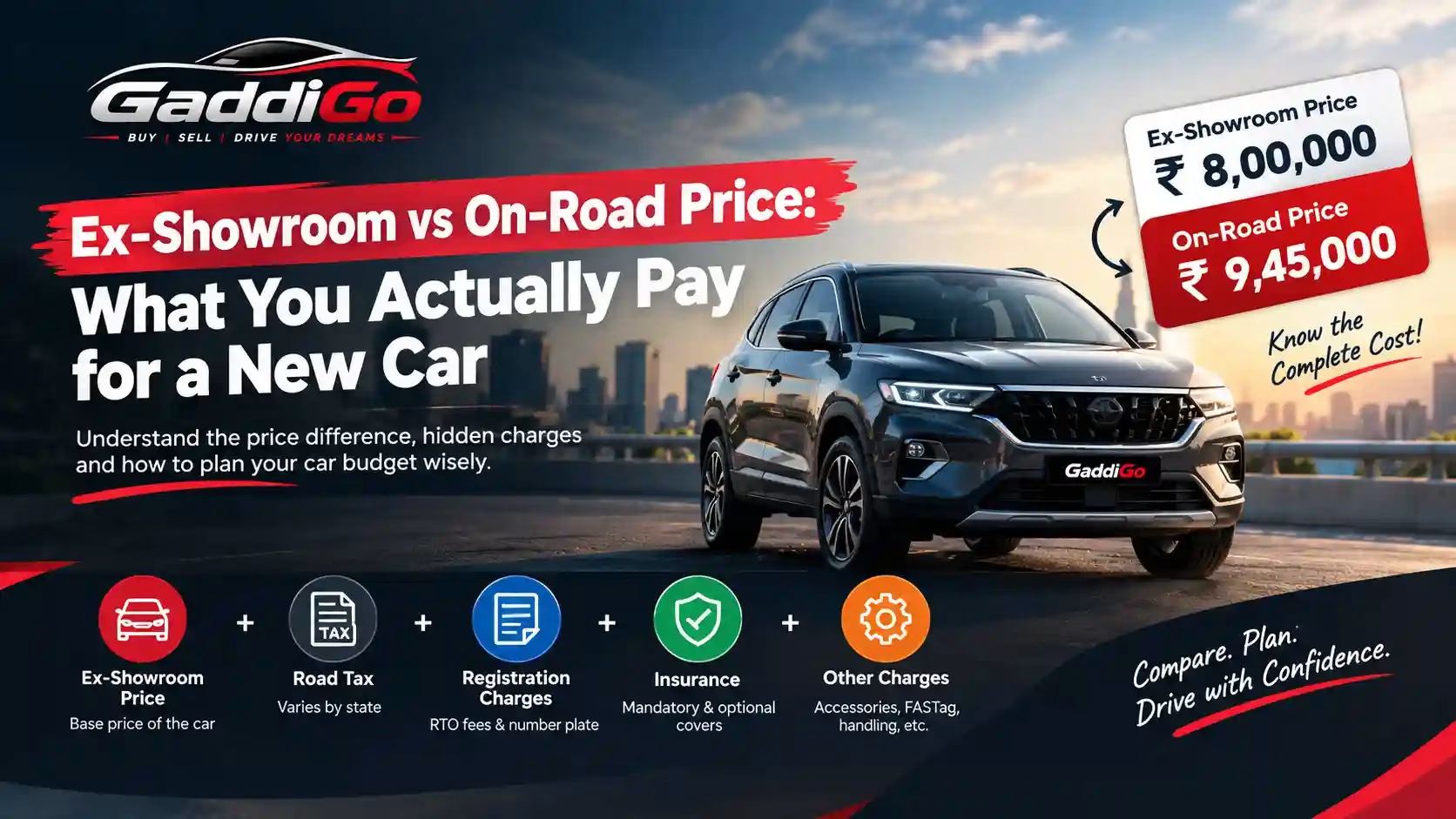
For example, if a car has an ex-showroom price of ₹8,00,000, this does not mean you can pay ₹8 lakh and immediately drive it home. Additional expenses are usually required before the car can be legally used on public roads.
What Does the Ex-Showroom Price Include?
The ex-showroom price generally includes:
-
The vehicle's selling price.
-
Applicable GST and other taxes already incorporated into that price.
-
The manufacturer's and dealer's built-in pricing components.
-
Relevant costs already included in the quoted vehicle price.
What Is Not Included?
The ex-showroom price generally excludes:
-
Road tax or lifetime tax, where applicable.
-
Vehicle registration charges.
-
Motor insurance.
-
Applicable number plate and related charges.
-
Optional accessories and extended warranty packages.
-
Other applicable charges not already included in the quoted price.
Understanding these exclusions helps you avoid confusing an advertised price with the amount you need to purchase the car.
What Is On-Road Price?
The on-road price is the total amount quoted for purchasing a new car and completing the necessary formalities to use it on public roads.
It starts with the ex-showroom price and adds applicable taxes, registration, insurance, and other relevant charges. It may also include optional accessories or additional services if you choose them.
In simple terms:
On-Road Price = Ex-Showroom Price + Applicable Taxes and Registration + Insurance + Other Agreed Charges
The exact amount depends on the vehicle, the state where you register it, your insurance selection, and any optional extras you accept.
For this reason, the same car can have different on-road prices in different cities or states.
Ex-Showroom Price vs On-Road Price: Key Differences
| Feature | Ex-Showroom Price | On-Road Price |
|---|---|---|
| Meaning | Advertised price before road-use formalities | Total amount payable after applicable charges |
| GST | Generally included | Already included through ex-showroom price |
| Road tax | Not included | Added where applicable |
| Registration | Not included | Added |
| Insurance | Not included | Added |
| Optional accessories | Usually excluded | May be included if selected |
| Varies by location | Can vary by market or manufacturer pricing | Often varies by state, city, and insurance |
| Best use | Comparing car models and variants | Planning your actual purchase budget |
The main difference is simple: the ex-showroom price helps you compare cars, while the on-road price tells you how much money you may actually need to complete the purchase.
Example: How Is the On-Road Price Calculated?
Suppose you are planning to buy a new car with an ex-showroom price of ₹10 lakh.
Here is an illustrative example of how additional costs could affect your budget.
| Price component | Illustrative amount |
|---|---|
| Ex-showroom price | ₹10,00,000 |
| Road tax | ₹1,00,000 |
| Registration and related charges | ₹10,000 |
| Insurance | ₹40,000 |
| FASTag and other applicable charges | ₹1,000 |
| Illustrative on-road price | ₹11,51,000 |
These figures are examples for explanation only, not an actual dealer quotation. Your road tax, registration costs, and insurance premium may differ.
In this example, the car advertised at ₹10 lakh would cost approximately ₹11.51 lakh on-road before any discounts or optional extras not shown above.
That is why it is important to ask for a complete, itemised quotation before making a booking payment.
Five Main Charges That Increase the On-Road Price
1. Road Tax
Road tax is a major part of the difference between the ex-showroom and on-road price. The applicable amount depends on the state where the vehicle is registered and may vary according to the vehicle's price, fuel type, or other state-specific criteria.
A car registered in one state may therefore have a different final cost from the same model registered elsewhere.
Buyer tip: Ask the dealer to show the applicable road tax separately in the quotation. Check the relevant state transport department's rules if you want to verify the calculation.
2. Registration Charges
A new car must be registered with the relevant transport authority. Registration-related costs may include the applicable registration fee, number plate charges, and other prescribed fees.
If you are financing the car through a loan, an applicable hypothecation entry may also add to the paperwork costs.
Buyer tip: Request a clear breakdown of government fees and other registration-related charges rather than accepting one unexplained lump sum.
3. Car Insurance
Insurance is another important expense when buying a new car. The applicable motor insurance cover must meet Indian legal requirements, and buyers commonly compare comprehensive policies that include third-party liability and own-damage protection.
Insurance premiums can differ depending on the insurer, vehicle, coverage, insured value, and optional add-ons.
You are not generally required to purchase your insurance from the same dealership selling the car. You can compare suitable policies independently, while ensuring the required cover is in place before driving the vehicle.
Buyer tip: Compare the coverage, exclusions, deductibles, and add-ons—not just the premium. A lower price is not necessarily better if the cover is inadequate.
4. FASTag and Number Plate Charges
FASTag is used for electronic toll payments, while a vehicle also needs the prescribed registration number plate.
These items may appear as separate lines in a dealer quotation. Check whether the charges are applicable and whether they are already included elsewhere to avoid paying twice for the same item.
Buyer tip: Ask for an itemised bill and retain receipts for applicable charges.
5. Accessories and Additional Packages
Dealerships may offer floor mats, seat covers, paint protection, extended warranties, maintenance packages, and other extras.
Some of these products may be useful, but not every buyer needs them. Optional products can increase the final amount significantly if you accept every package offered.
Buyer tip: Ask the dealer to separate mandatory charges from optional items. Choose accessories and packages according to your needs and budget.
Are Dealer Handling Charges Mandatory?
If a quotation includes a handling, logistics, or similar charge, ask the dealership to explain exactly what it covers and whether it is permitted under the applicable rules.
Do not assume that a charge is mandatory simply because it appears on a quotation. Equally, do not assume every additional charge is improper without examining what it represents.
Request a written, itemised quotation and question any unclear or duplicate charges before paying.
How Can You Reduce the On-Road Price of a New Car?
You may not be able to negotiate government taxes or prescribed registration fees, but there are several ways to manage your overall purchase cost.
1. Compare Offers From Different Dealers
Ask more than one authorised dealership for a written quotation for the same model, variant, and fuel type. Compare discounts, exchange offers, and the final payable amount.
2. Compare Insurance Options
Obtain insurance quotations from different insurers and compare equivalent coverage. Check whether optional add-ons provide meaningful value for your situation.
3. Decline Unwanted Accessories
You do not need to accept every accessory or protection package offered by a dealership. Ask for a quotation without optional extras and add only the products you want.
4. Check Manufacturer Offers
Manufacturers and dealers may provide discounts, exchange benefits, or promotional schemes. Confirm eligibility, validity dates, and any conditions attached to the offer.
5. Set Your Budget Using the On-Road Price
Do not calculate affordability using the ex-showroom price alone. Consider the down payment, loan amount, EMI, insurance renewals, fuel or charging costs, servicing, and other ownership expenses.
A car that fits your advertised-price budget may still be too expensive once all costs are considered.
Why Does the On-Road Price Differ Between Cities?
The on-road price can change depending on where the car is registered and the insurance quotation you receive.
Important factors include:
-
State-specific road tax rules.
-
Registration and applicable statutory fees.
-
Insurance premium and selected coverage.
-
Vehicle model, variant, and fuel type.
-
Optional accessories and additional services.
-
Discounts and offers available at the dealership.
Before comparing prices online, make sure you are comparing the same variant and the same type of quotation. An ex-showroom price from one location should not be compared directly with an on-road price from another.
Checklist Before Booking Your New Car
Use this checklist before paying a booking amount or finalising a purchase.
-
Confirm the exact model, variant, and fuel type.
-
Obtain the latest ex-showroom price.
-
Ask for an itemised on-road quotation.
-
Verify road tax and registration charges.
-
Compare insurance options and coverage.
-
Identify optional accessories and packages.
-
Check applicable discounts and their conditions.
-
Review the payment schedule and booking cancellation terms.
-
Confirm the final amount in writing.
-
Keep receipts and copies of relevant documents.
Completing these checks can help you understand where your money is going and reduce the chance of unpleasant surprises at delivery.
Conclusion
Understanding the difference between ex-showroom and on-road price is an important step when buying a new car in India.
The ex-showroom price gives you a starting point for comparing vehicles, but the on-road price includes the applicable costs required to complete the purchase. Road tax, registration, insurance, and selected extras can make a noticeable difference to your final budget.
Before committing to a car, compare written quotations, verify unclear charges, evaluate insurance options, and avoid paying for add-ons you do not need.
At GaddiGo, you can explore car-related information and compare your options as you work towards finding a vehicle that suits your needs and budget. Make your decision based on the total cost—not just the price displayed in an advertisement.
Frequently Asked Questions (FAQs)
1. What is the difference between ex-showroom and on-road price?
The ex-showroom price is the advertised price before adding road tax, registration, insurance, and other applicable charges. The on-road price is the total amount quoted after these costs are added.
2. Is GST included in the ex-showroom price?
Yes, the applicable GST is generally included in the ex-showroom price. Buyers should check the quotation to understand how the vehicle's price and applicable taxes are presented.
3. Why is the on-road price higher than the ex-showroom price?
The on-road price includes additional expenses such as road tax, registration, insurance, and other applicable charges. Optional accessories and packages can increase it further.
4. Can the on-road price of the same car vary between states?
Yes. State-specific road tax rules and registration-related costs can cause the on-road price to differ. Insurance quotations and dealership offers may also affect the final amount.
5. Can I buy car insurance outside the dealership?
Yes. You can generally choose an insurer independently, provided the vehicle has the legally required insurance cover. Compare policy coverage, exclusions, and premiums before choosing.
6. Are accessories compulsory when buying a new car?
Optional accessories and add-on packages are not automatically compulsory. Ask the dealer to identify optional items separately and confirm the terms before accepting them.
7. Which price should I use when planning my car budget?
Use the on-road price to estimate the amount needed to complete the purchase. Also account for future expenses such as fuel, servicing, insurance renewals, and loan interest.
8. How can I check whether a dealer's on-road quotation is correct?
Ask for an itemised quotation, verify applicable government charges with the relevant authorities, compare insurance quotations, and question any unclear or duplicate fees before making payment.